
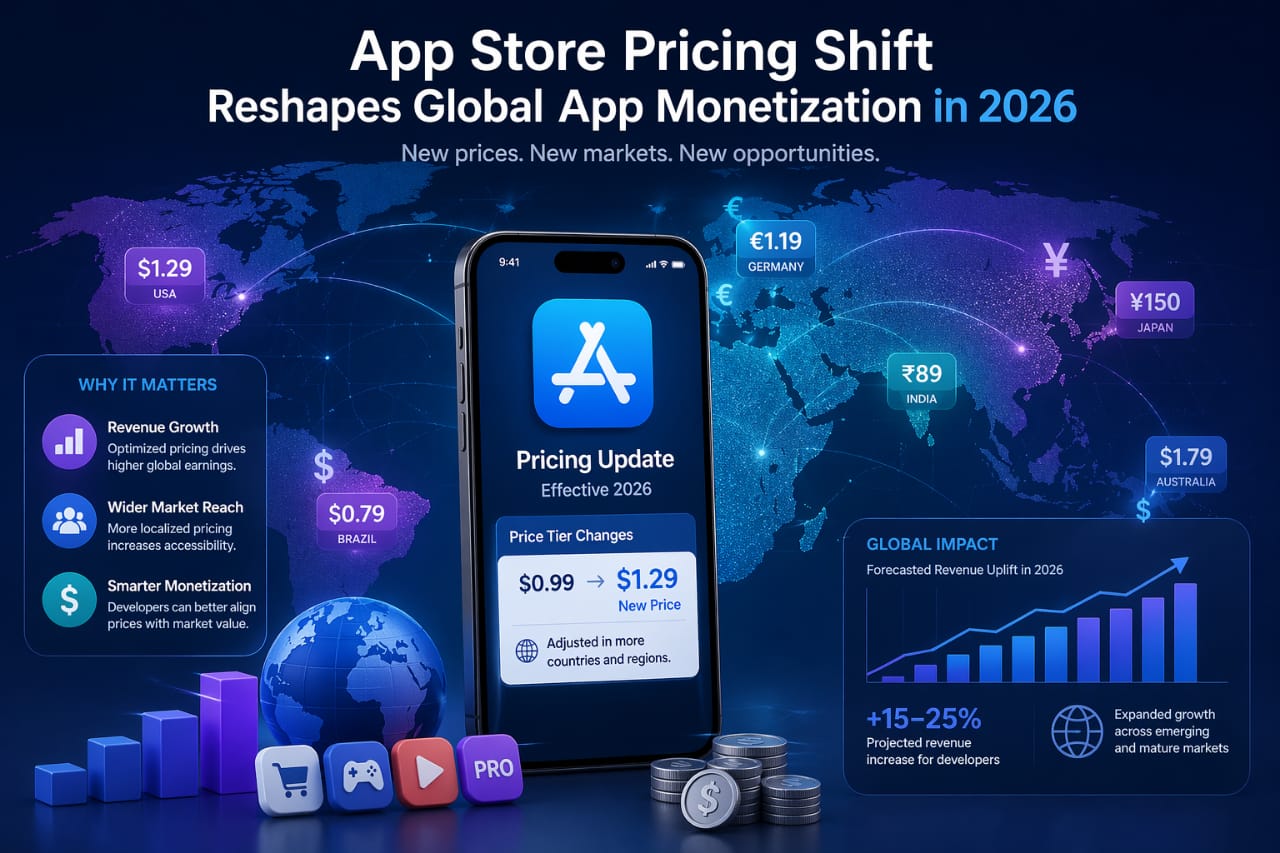
The App Store pricing shift is redefining how mobile apps generate revenue in 2026, and it is already forcing developers and publishers to rethink their global monetization strategies. The App Store pricing shift is not just a technical adjustment; rather, it reflects broader changes in digital commerce and regulatory pressure across major markets. Meanwhile, developers are adjusting pricing tiers across regions to remain competitive while still maintaining profitability.
The App Store pricing shift has been influenced heavily by ongoing regulatory changes in Europe and Asia, where app marketplaces are being pushed toward more transparent pricing structures. Therefore, Apple has gradually introduced more flexible pricing tools for developers, allowing localized pricing adjustments that reflect purchasing power differences. In addition, Google Play has followed similar patterns, ensuring parity across ecosystems to avoid developer migration.
One of the most significant impacts of the App Store pricing shift is seen in subscription-based apps. Consequently, developers of productivity apps, fitness platforms, and digital content services are restructuring their monthly and yearly pricing models. However, this shift is not uniform across all categories, as gaming apps are responding differently due to in-app purchase dynamics and user spending behavior.
The App Store pricing shift is accelerating the global subscription economy, especially for apps that rely on recurring revenue models. Meanwhile, users are becoming more sensitive to subscription fatigue, which is forcing developers to introduce hybrid monetization strategies. For example, many apps are now combining free tiers with ad-supported models alongside premium subscriptions.
As a result, app publishers are experimenting with regional pricing flexibility more aggressively. Therefore, a user in Southeast Asia may see significantly different subscription pricing compared to a user in North America or Europe. In addition, this localized pricing strategy is helping developers improve conversion rates in emerging markets.
However, this also creates complexity in revenue forecasting. Consequently, financial planning for app businesses has become more dynamic and dependent on real-time analytics. Meanwhile, analytics tools integrated into app stores are becoming essential for developers to understand user behavior across regions.
The App Store pricing shift is also intensifying competition among developers, especially in saturated categories such as streaming, education, and productivity. Therefore, smaller developers are leveraging aggressive pricing strategies to compete with established global brands. In addition, some startups are focusing on niche markets to avoid direct competition with large-scale apps.
Meanwhile, larger companies are using their scale advantage to absorb pricing fluctuations. For example, enterprise-level productivity apps are bundling services to justify higher subscription costs. Consequently, this bundling approach is becoming a dominant trend in premium app ecosystems.
The App Store pricing shift has also encouraged cross-platform strategy development. Therefore, many developers are now ensuring price parity between iOS and Android ecosystems to prevent user fragmentation. However, slight differences still exist due to platform fees and regional taxation policies.
Regulation has played a critical role in the App Store pricing shift, especially in regions like the European Union where digital market laws are reshaping platform economics. Meanwhile, Apple and Google are being required to provide more transparency in how they calculate commissions and developer fees.
As a result, developers are gaining more visibility into revenue breakdowns. Therefore, this transparency is allowing better financial planning and improved pricing experimentation. In addition, regulators are pushing for alternative payment systems, which may further reduce reliance on traditional in-app purchase mechanisms.
However, platform owners argue that these changes could increase security risks and reduce user trust. Consequently, debates between regulators and platform companies continue to shape the future of app distribution. Meanwhile, developers are carefully monitoring policy updates to avoid compliance risks.
The App Store pricing shift is particularly impactful in emerging markets such as Africa, Southeast Asia, and Latin America. Therefore, developers are increasingly focusing on affordability and localized payment methods. In addition, mobile-first economies are driving rapid growth in app downloads and engagement.
For example, fintech apps are adjusting pricing models to accommodate micro-transactions and low-income user segments. Meanwhile, social media platforms are experimenting with ad-heavy free versions to maintain accessibility. Consequently, user acquisition strategies are becoming more region-specific.
The App Store pricing shift is also encouraging partnerships with telecom operators and local payment providers. Therefore, users can now subscribe to apps through mobile carrier billing systems in several countries. In addition, this reduces friction in payment processing and increases conversion rates.
The App Store pricing shift is reshaping competitive positioning across the global app ecosystem. Meanwhile, companies that adapt quickly are gaining market share, especially in subscription-heavy categories. Therefore, agility in pricing strategy is becoming a key competitive advantage.
However, companies that fail to adjust are experiencing stagnating growth. Consequently, app store optimization strategies now include pricing experiments as a core component. In addition, A/B testing for subscription tiers has become standard practice among growth teams.
The App Store pricing shift is also influencing investor sentiment. Therefore, venture capital firms are closely analyzing monetization resilience before funding app startups. Meanwhile, predictable revenue models are being prioritized over aggressive user acquisition strategies.
The App Store pricing shift is expected to continue evolving as digital ecosystems mature. Therefore, we may see even more granular pricing systems based on user behavior, geography, and device type. In addition, cross-platform subscription bundles may become more common as companies aim to reduce churn.
However, uncertainty remains around regulatory alignment across global markets. Consequently, developers must remain flexible in their monetization approaches. Meanwhile, app stores will likely continue refining their revenue-sharing models to balance ecosystem growth and platform sustainability.
As a result, the App Store pricing shift is not just a temporary adjustment but a long-term transformation in how digital products are valued. Therefore, developers, publishers, and users are all adapting to a more dynamic and regionally sensitive pricing environment.


