Four Humans Are Currently Beyond Earth Orbit
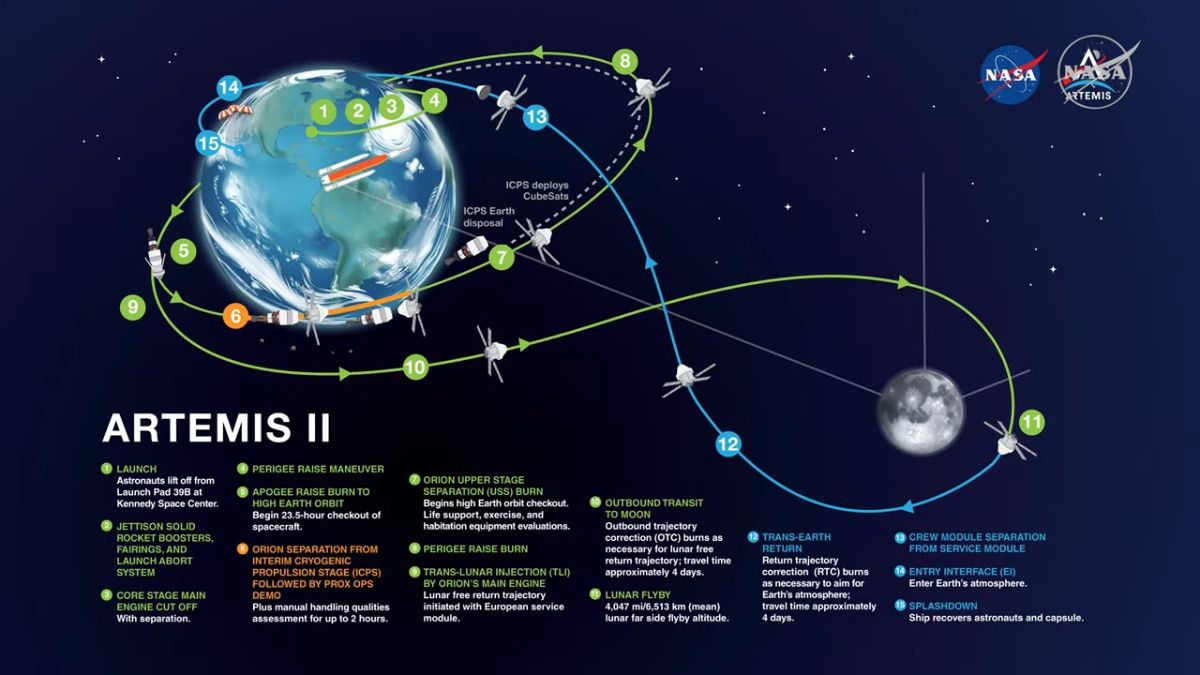
As of April 4, 2026, the Artemis II crew, Commander Reid Wiseman, Pilot Victor Glover, Mission Specialist Christina Koch, and Canadian Space Agency astronaut Jeremy Hansen, are further from Earth than any human has been since Apollo 17 in December 1972. The crew is executing a 10-day mission that will take them on a looping trajectory around the Moon’s far side before lunar gravity sends them back toward Earth.
The Orion spacecraft, officially named Integrity, lifted off from Kennedy Space Center at 6:35 p.m. EDT on April 1, carried by the Space Launch System rocket. The translunar injection burn on April 2 was, in the words of NASA, flawless. The crew has since confirmed all systems are nominal, tested the spacecraft’s proximity operations capability, and provided video footage from beyond Earth orbit that was watched by hundreds of thousands of people live.
What Artemis II Is Actually Testing
Artemis II is not a landing mission. Its objectives are to validate every system on the Orion spacecraft under real deep-space conditions: life support, navigation, communication, re-entry heat shield performance, and the crew’s ability to operate the vehicle manually in proximity to another spacecraft in deep space.
The proximity operations demonstration, which pilot Victor Glover executed this week, tested Orion’s manual maneuvering capability by approaching and flying around the spent Interim Cryogenic Propulsion Stage used to push the spacecraft out of Earth orbit. This procedure simulates the docking operations that future Artemis missions will require when astronauts need to rendezvous with the commercial lunar landers provided by SpaceX and Blue Origin.
SpaceX’s $1.75 Trillion IPO: The Biggest in History
SpaceX filed for its initial public offering on the same day NASA launched Artemis II. The filing targets a valuation of $1.75 trillion, which would make it the largest IPO in history. SpaceX currently holds a private valuation of approximately $1.3 trillion. The company dominates the global launch market, accounting for more than half of all orbital missions worldwide. Its Starlink satellite internet service serves over 10 million customers through a constellation of more than 10,000 satellites.
The timing of the IPO filing alongside the Artemis II launch was deliberate and effective. Space stocks rallied on April 1, with Rocket Lab, Intuitive Machines, and AST SpaceMobile each rising 2% or more in premarket trading. The Artemis II launch validated the long-term narrative of human space exploration at scale. The SpaceX IPO filing provided the capital mechanism that will fund the next phase of private space development.
The Role SpaceX Will Play in the Next Moon Landing
SpaceX is not just a launch provider for the Artemis program. It is building the Starship Human Landing System, the vehicle that will carry astronauts from lunar orbit to the surface of the Moon. The HLS contract is the most complex and commercially significant space contract in NASA’s history, worth billions of dollars in development and flight payments.
The challenge is orbital refueling. Starship HLS requires approximately ten tanker launches worth of propellant loaded into a fuel depot in low Earth orbit before it has enough fuel to complete the lunar journey. SpaceX has not yet demonstrated orbital refueling at scale. Until it does, the Artemis landing mission, currently scheduled as Artemis IV in 2028, remains dependent on a capability that has not yet been proven.
The Space Force Award and What It Signals
On April 1, the U.S. Space Force awarded SpaceX a $178.5 million task order to launch missile tracking satellites for the Space Development Agency starting in 2027. The award is significant not just for its dollar value but for what it represents: SpaceX is now considered a national security launch provider, not just a commercial or exploration company. The integration of SpaceX’s launch capabilities into U.S. missile defense infrastructure is a strategic development that adds a national security dimension to its IPO story.
What Comes After Artemis II
The mission sequence from here is as follows: Artemis II returns to Earth with a splashdown off the coast of San Diego. Artemis III, planned for mid-2027, will test SpaceX’s Starship HLS and Blue Origin’s Blue Moon landers in low Earth orbit, without a lunar landing. Artemis IV, targeted for 2028, will be the first crewed lunar landing since Apollo 17. The South Pole of the Moon is the target, where water ice deposits confirmed by previous robotic missions offer the possibility of in-situ resource utilization for future long-duration missions.
China is planning its own crewed lunar mission, currently projected for no earlier than 2030. The United States intends to land astronauts on the Moon before China does. The space race of 2026 is quieter than the one in 1969, but it is driven by the same combination of national prestige, scientific ambition, and strategic competition.
Be the first to comment